

Signs of Termite Dust and How to Identify It
Content Updated: February 11th, 2026
Key takeaways
- Drywood termites leave behind a substance that looks like sawdust but is actually their excrement, known as frass.
- At first glance, termite dust can look like a pile of sand, but if you look closer it is pellet-shaped and resembles tiny, deflated footballs. The color can vary from light beige to black, depending on the kind of wood the termites are consuming.
- Termite dust (frass) often accumulates in areas like window and door sills and in or around porches.
- Other signs of drywood termites include discarded wings, pinhole sized kickout holes near mounds of frass, and hollow sounding wood.
- If you see signs of termite dust, contact a termite control expert immediately to get started on treatment.
Jump to section:
Drywood termites and termite frass
Other signs of a drywood termite infestation
Homeowners often notice small piles of what looks like sawdust around their home and worry that termites are to blame—but termites don’t actually leave behind sawdust. In many cases, this material is frass, which is termite excrement and a common sign of drywood termite activity. The presence of termite dust (aka frass) indicates that insects may be infesting the wood in or around your home, and it shouldn’t be ignored. Learn more about termite dust and what to do if you notice signs of termite activity in your home.
Drywood termites and termite frass
Drywood termite swarmers are usually pale brown in appearance, though they can also be dark brown or light, yellowish-tan. Their size depends on their role in the termite caste system. Soldiers protecting the colony tend to be three-eighths of an inch long, while both male and female reproductives are about one-half inch in length.
Drywood termites can be difficult to detect. They don't require contact with soil and live deep inside wood found in structures or furniture. The colonies can be made up of 1,000-3,000 insects. Because of their largely hidden habitat, they are rarely seen except during the summer and fall, when flying reproductives, called swarmers, leave the nest to create new colonies.
Fortunately, drywood termites are also detailed insects that like to keep their tunnels and colony areas clean and free of fecal matter. They bore tiny “kickout holes,” from the inside of the wood they've infested and use them to expel fecal matter (frass). This is fortunate because it can help homeowners and professionals identify a termite problem.
This frass often accumulates in areas like window and door sills and in or around porches where it can easily be seen. It's also typically one of the first signs of a termites. If the termites have invaded areas like walls or ceilings, however, the frass often falls on floors and carpets and goes unnoticed.
What termite frass looks like
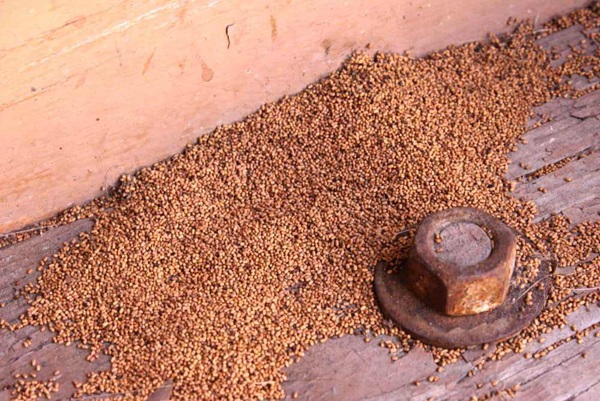
Because drywood termites consume dry wood (true to their name), frass excreted by drywood termites is dry and pellet shaped. When in piles, the frass can look like sawdust or sand. The color can vary from light beige to black, depending on the kind of wood the termites are consuming. If you used a magnifying glass to examine the frass, the individual pellets would look something like tiny, deflated footballs.
If you see anything in your home that looks like sawdust, stop and take a closer look. Don’t sweep or vacuum away anything that might be termite frass as this can be a sign that a termite control professional would need to see during an inspection.
Other signs of a drywood termite infestation
In addition to termite sawdust (frass), other indications of an infestation can include:
Discarded wings left behind by the swarmers establishing new colonies.
Pinhole sized kickout holes (less than 2mm in diameter), which can be near the mounds of frass. Carefully tap on the walls, and if there are termites, you may hear a hollow sound.
Termite treatment options
Treatment for drywood termite infestations can be categorized as either whole structure or localized, depending on the size of the infestation.
Because it can be so difficult to detect drywood termites and determine the extent of the damage, do-it-yourself treatments are not advised. If you see signs of a termite invasion in your home, such as piles of “termite sawdust,” it’s better to call in the professionals at Terminix®.
Also, there are other insects, like carpenter ants and carpenter bees, that can produce frass. So, just because you see frass does not necessarily mean that you have a termite problem. Which is even more reason why calling on a professional when you spot frass is so important. Contact Terminix today for a free inspection.